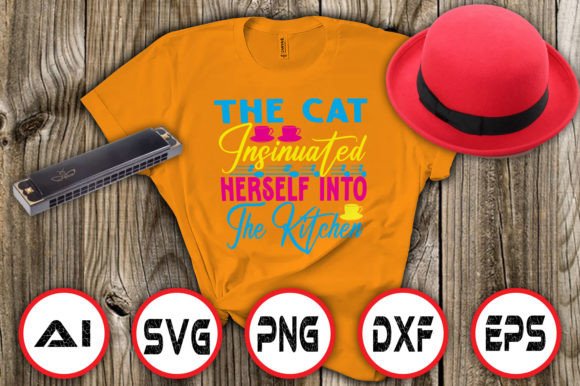
The Cat Insinuated Herself into the Kitc
Let’s be honest—when I first opened The Cat Insinuated Herself into the Kitc, I didn’t expect to pause mid-scroll. There’s a quiet confidence in its simplicity: a single feline silhouette, slightly off-center, tail curling just past the implied edge of a kitchen counter. No whiskers, no eyes, no clutter—just posture, presence, and that deliciously sly verb “insinuated.” It’s not a cartoon cat. It’s a mood. A whisper of domestic chaos, warmth, and quiet rebellion—all in one clean vector outline.
I tested it immediately on a linen tea towel for a local boutique’s spring collection. The client wanted something that felt handmade but not twee—whimsical without being cutesy, relatable without leaning into meme culture. The Cat Insinuated Herself into the Kitc landed perfectly. Stitched in soft ecru thread on natural flax, it read as thoughtful, intentional, and quietly joyful—not a gag, not a trend, but a tiny moment of shared recognition between maker and buyer.
Where This Design Earns Its Keep
This isn’t a design built for flash—it’s built for resonance. As an embroidery file, it thrives where subtlety matters: on kitchen towels, aprons, baby onesies, linen pillow covers, and unstructured tote bags. Its open shape and minimal internal detail translate beautifully into satin stitch outlines or delicate running-stitch interpretations. On a sweatshirt? Yes—but choose a medium-weight cotton blend, not a thick fleece. On a cap? Only if you’re using a low-profile hoop and a light stabilizer; the curve demands breathing room.
For Etsy sellers and small shop owners, this is a quiet workhorse. It pairs effortlessly with hand-lettered phrases (“Made with Love & Slightly Uninvited Guests”) or stands alone as a minimalist brand mark. I’ve seen it stitched onto ceramic mug sleeves (with careful hoop placement) and embroidered patches for café aprons—always landing as warm, clever, and authentically handmade.
Where Caution Is Warranted
Don’t force it where it doesn’t belong. Avoid stretchy knits like jersey tees unless you’re using cutaway stabilizer *and* testing tension thoroughly—the clean lines can blur under fabric movement. Thin fabrics like voile or rayon challis need extra backing; the design’s confident silhouette reads best when it holds its shape. On dark fabric? Absolutely—just confirm your thread color has enough contrast. I ran a quick black-on-charcoal test and found the shape held up, but only because the stitch density stayed light and even.
Small hoop sizes (under 4” diameter) will require smart placement—this isn’t a design to cram into a corner. Its charm lives in its implied space, so give it room to breathe. And skip dense fill-stitch interpretations unless you’re aiming for bold graphic impact; the original vector’s elegance lies in its line work, not mass.
What It Does for Your Finished Product
The Cat Insinuated Herself into the Kitc elevates perceived value without demanding premium pricing. Customers notice it—not as decoration, but as *recognition*. That little cat says, “I see you. I know your kitchen is also a negotiation zone.” It builds trust because it feels observed, not outsourced. For craft businesses, that translates to repeat buyers and word-of-mouth referrals.
Visually, it supports brand consistency without locking you into a rigid style. Pair it with earthy thread palettes for a cottage-core line, or crisp monochrome for modern apparel branding. It scales well—from 2.5” on a baby bib to 6” on a market tote—without losing legibility or charm. And yes, it works in printable mockups: the SVG renders cleanly at any resolution, making digital product previews look polished and intentional.
Practical Designer Notes Before You Stitch
- Always test on scrap fabric first—especially if pairing with textured weaves or layered garments like reversible aprons.
- Check thread color contrast on both light and dark backgrounds before committing to a full run.
- Review stitch density in your embroidery software—if converting from vector to machine embroidery, avoid overloading small curves with too many stitches.
- Confirm hoop size and placement early; this design benefits from centered or lower-third positioning on most items.
- Inspect small details like tail taper and ear points—they should remain distinct after stitching, not blob together.
- Test in black-and-white mockups to ensure readability at thumbnail size (critical for Etsy listings).
- Use appropriate stabilizer: tear-away for stable wovens, cutaway for knits or lightweight fabrics.
- Verify licensing terms before selling finished products or bundling this as part of a commercial embroidery collection—even though it’s listed under Freebies, commercial use rights aren’t automatic.
As a designer who’s reviewed hundreds of embroidery files—from intricate floral bouquets to pixel-perfect logos—I keep returning to The Cat Insinuated Herself into the Kitc not because it’s flashy, but because it’s considered. It understands scale, context, and human attention spans. It doesn’t shout. It leans in—and invites the viewer to do the same.
If you’re building a cohesive line of kitchen-themed handmade products, launching a new craft business, or simply choosing a design that reflects your voice—not just your skill—this one earns its place in your library. It’s not just another graphics download. It’s a quiet collaborator in your next embroidered patch, your next holiday gift, your next small shop bestseller.